
Is Local SEO Worth It? An Honest Answer for Outdoor Living Businesses


If you run a landscaping, pool building, or any other high-ticket contracting company doing $1M to $3M a year, you probably got there the old fashioned way. You do the absolute best work, your customers tell their neighbors, and the referrals keep on coming. Maybe somewhere along the way you tried "marketing." Maybe some Google Ads, maybe a Facebook campaign, maybe an SEO package an agency talked you into. And it didn't really go anywhere.
So now you're asking the question honestly: is local SEO worth it?
Short answer: yes, but probably not the version of SEO you tried before. Let me explain what I mean.
Why your last attempt at SEO didn't work
I audit home service and outdoor living businesses across the Texas Hill Country from San Antonio to Austin, and when SEO has failed them, it's almost always one of three stories:
The first is old school SEO. They (or their agency) were stuffing keywords, chasing rankings, and trying to hack the system instead of doing what Google and AI systems are actually built to reward: answering a real customer's question and being the clear solution to their problem. Tricks that worked in 2015 don't just underperform now, they can actively hold you back.
The second is the agency that charged thousands a month and reported back with "your traffic is up!" Traffic that can't be tied to a lead or a booked job isn't a result. It's a chart. If you've been burned this way, your skepticism is earned.
The third is inconsistency. SEO got "tried" for two or three months, nothing dramatic happened, and it got dropped. The problem is that SEO compounds. The more consistent you are, the more Google and AI systems trust you, and the higher they rank you over time. Quitting at month three is like pulling a brisket off the smoker after an hour and declaring smoking doesn't work.
The real question isn't money. It's time.
Here's something that agencies won't tell you: SEO is mostly free. You can write your own blog posts, build your own service pages, post on social media, and ask your own customers for reviews without spending a dime. The hard costs are optional things like backlinks, PR, or software like SEMrush or Local Falcon, and even those have a free fallback in Google Search Console.

That means if local SEO brings you even one pool build or one full landscape installation, the financial return is enormous. The real cost is your time.
So the math you actually need to run is this. Say your time is worth $100 an hour and doing SEO well would take you 20+ hours a month. An agency charging $2,000 a month just broke even with your time before you count their expertise, and that's before your revenue starts climbing. If an agency can prove they're getting you customers, $1,000 to $5,000 a month can be a genuine bargain. If they can't prove it, walk away. More on how to test that in a minute.

How long does local SEO take to work?
I hate saying "it depends," but it depends. Here's the honest version.
If you're in a competitive market, we don't start by fighting for the most obvious keyword. We go after longer tail searches with less competition, because searches are getting more and more specific. We can often get a client ranking number one for those longer tail terms in under a month. The broader, more common keywords take longer depending on your competition and where you're starting from.
But the goal was never "rank number one for everything." The goal is to rank for what gets you customers. And it builds on itself. Every month of consistent, useful content makes the next month easier.
What about AI? Doesn't ChatGPT change everything?
It changes a lot, and mostly in your favor if you do this right.
According to SEMrush, Google still drives roughly 90% of global organic search traffic, while AI platforms like ChatGPT and Perplexity account for less than 1% of total web traffic. But here's the part that matters: AI traffic converts at up to 4x to 5x higher rates. It behaves like a warm word of mouth referral, not a cold click.
I've watched this happen with a pool builder I work with, South Texas Custom Pools. Homeowners were asking AI tools for pool design ideas, and the AI recommended them as the builder who could actually make those ideas happen. Those conversations turned into real jobs. The traffic numbers looked small. The revenue didn't.
The good news is that the same work feeds both machines. Google and the AI systems are looking for the same thing: a business that clearly answers the customer's question. Local SEO done right today is also AI optimization.
Here's what you may not want to hear...
Your goal is no longer to rank number one on Google.
In this new age of Q&A search, your primary goal is to answer your customer's question before someone else can. Even if you win the top organic spot for "patio builder near me," you're still sitting below the AI overview, the ads, and the map pack. Meanwhile, the homeowner two miles from you is typing "how much money do I actually save by building my own patio?" and whoever answers that question well, for their part of town, wins the conversation before your competitors even know it happened.
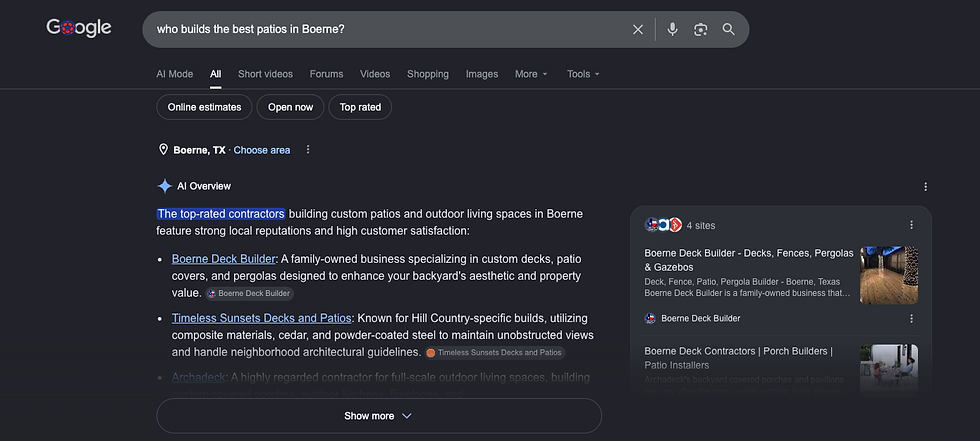
Get specific. Get local. Answer the questions people are actually asking.
If you're starting this week, do these things in order
Start with your Google Business Profile. Google still puts it at the top of the results page right under the AI recommendation, and AI tools pull from your GBP for reviews, services, photos, and updates. It's the highest leverage hour you'll spend.
Then build service pages, and after that, location pages. In that order. Each one should answer the questions a customer actually asks when they're looking for that service, not just list what you do.
And if your site is portfolio heavy (most outdoor living sites are), make sure those beautiful project photos are working for you. Include geo data and tag your images with local indicators so Google knows that stunning pool was built in Boerne, not nowhere.
One thing you can skip for now: obsessing over the technical stuff. Keyword density, exact word counts, schema markup. Helpful, but not worth your time at this stage. Answering questions well is.
SEO or ads first?
I manage both for clients, so I don't have a dog in this fight. SEO first.
Think of SEO as logs on a fire and ads as lighter fluid. Lighter fluid without logs is a big flash that disappears the moment you stop pouring. Logs burn long, and when you do add lighter fluid later, there's something there to catch. SEO builds the brand and trust that make your ads work better when you're ready for them.
How to know it's actually working
This is where most agencies hide, so don't let yours.

We track the full funnel. Are we getting more traffic and AI mentions? Are those turning into leads, which we track with dedicated phone numbers and UTM parameters? And are those leads closing? We even compare the close rate of organic digital leads against word of mouth referrals and paid traffic.
The simple version any owner can set up: a phone number pool that separates your digital organic leads from your in person referrals and your paid channels, plus basic UTM tracking. Tools like CallRail or HighLevel make this inexpensive.
And if you're interviewing agencies, ask one question before you sign anything: "How do you measure success, and can I see what that looks like?" If the answer is vague, or it's just traffic charts, keep looking.
So, is local SEO worth it?
For an outdoor living business at your size, built on referrals, with a market full of homeowners asking very specific questions about patios, pools, and outdoor kitchens? Yes. Not because SEO is magic, but because you already have what the algorithms are looking for: real expertise and real results. The work is making that visible and answering questions before your competitors do.
If you'd like to know where you stand right now, I'll take a look. Book a free strategy call with Hey There Digital and we'll walk through your current rankings, your Google Business Profile, and where the easiest wins are hiding. No pitch deck, no traffic charts, just an honest look at whether this is worth your time.


Comments